


Hollywood Regency in Key West: The Style, the Stars and the Story of Marrero's
Updated: Sep 25
Walk into Marrero's and the first thing guests notice is the pattern: bold pinstripes, tropical botanicals, Hollywood Regency furniture and color turned all the way up, set inside the high-ceilinged rooms of a Victorian cigar maker's mansion.
The look is deliberate. Hollywood Regency style belongs to the era when the film industry came to Key West and the island's writers drank with the stars, and our redesign borrows from it on purpose.
This is the story of the style, the Key West places where you can still see it, and the house on Fleming Street where it lives today, including two pieces of the original mansion that have been here since the Marrero's moved in.
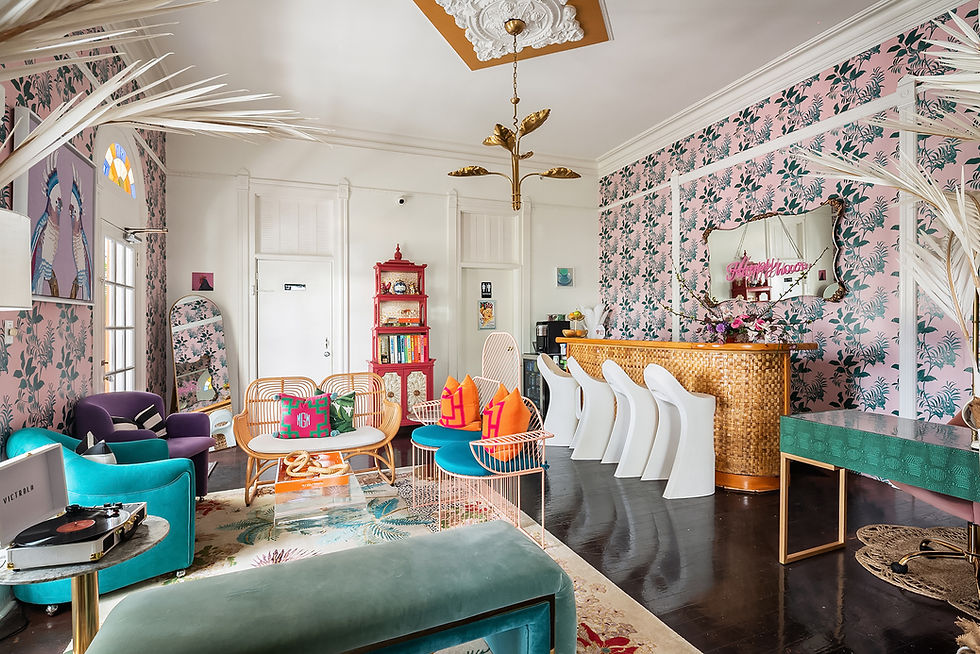
What is Hollywood Regency style?
Hollywood Regency is the interior style of Hollywood's golden age, roughly the 1930s to the 1950s. It took the proportions of classic Regency design and gave them a movie star's confidence: high contrast, glossy surfaces and nothing held back.
The look is most often traced to two decorators. Dorothy Draper, one of the first women to run an American interior design firm, made her name with wide stripes, oversized florals, black-and-white checkerboard floors and saturated color.
William Haines, a silent-film actor turned decorator, furnished the homes of Hollywood's stars with the same sense of glamour. Between them they defined the vocabulary: checkerboard and pinstripe, animal prints and big botanical florals on rugs, curtains and cushions, pinks set against blues, mirrored furniture and walls, and the sunburst mirror above all.
The aim was a balance of frivolous elegance and real comfort. These were rooms for entertaining, meant to be lived in rather than looked at.

Palm Beach Regency: the Florida version
In Florida, the style softened into what designers now call Palm Beach Regency.
It keeps the glamour and the pattern but lets in the light: more white, more greenery, more tropical print, and the relaxed ease of a house built for warm weather. You can see its descendants in the prints of Lilly Pulitzer, and you can see it in the Florida mansions and hotels that were decorated in its heyday.

Key West and the silver screen
Key West never had Hollywood's studios, but for a few decades in the middle of the last century it had its attention. Ernest Hemingway wrote here through the 1930s. Tennessee Williams arrived in the 1940s and stayed for the rest of his life. President Harry S. Truman spent his winters at the Little White House, and the island's bars and hotels filled with people who wanted to be near them.
The films followed. Key Largo (1948), with Humphrey Bogart and Lauren Bacall, put the Florida Keys on marquees across the country, although it was shot almost entirely on Hollywood soundstages. The Rose Tattoo (1955), adapted from Tennessee Williams's play, was filmed on location in Key West and won Anna Magnani the Academy Award for Best Actress. In 1959 Cary Grant and Tony Curtis came to the island's naval station to film Operation Petticoat.
Which celebrities lived in Key West?
The names most closely tied to the island are writers rather than actors. Hemingway lived at 907 Whitehead Street through the 1930s, and the house is now the Ernest Hemingway Home and Museum. Tennessee Williams made Key West his home from the late 1940s until his death in 1983, and the Tennessee Williams Museum tells his story. The poet Elizabeth Bishop lived here too, and Truman returned winter after winter. The film stars mostly came to work and went home again, but they left the island with a taste for glamour that never quite wore off. Our guide to Key West's literary history covers the writers in more depth.
Where to see Hollywood Regency in Key West today
Much of the island's golden-age glamour was lost to weather and time, but a few landmarks remain, and three of them are within a few minutes' walk of Marrero's.
The Strand Theater
At 527 Duval Street, about three minutes from our door, the Strand Theater opened in the 1920s and screened silent films and then talking pictures for decades. It later housed a Ripley's Believe It or Not! Odditorium, and today it is a Walgreens, which restored the facade and kept the marquee. The building is a drugstore inside now, but every night the marquee still lights up the 500 block of Duval.
La Concha Hotel
La Concha, at 430 Duval Street on the corner of Fleming, is two minutes' walk from Marrero's. It opened in 1926 as Key West's first luxury hotel, six stories of Spanish Colonial Revival with marble floors, private baths and an electric elevator, and in 1991 it became one of the first members of Historic Hotels of America. Hemingway and Truman came for cocktails. Tennessee Williams stayed at the hotel in the mid-1940s while working on A Streetcar Named Desire. You can read more about its past on the Historic Hotels of America site.
Tropic Cinema
Just off Duval at 416 Eaton Street, about three minutes away, the Tropic Cinema is a love letter to the movie palaces of old Hollywood. It is newer than it looks, having opened in 2004, and it was given an aqua Art Deco marquee, neon accents and an island version of the Hollywood Walk of Fame out front. A statue of Marilyn Monroe in her white dress stands by the entrance, and the programme runs to independent films, international releases and golden-age classics. It is a good plan for a rainy evening, or any evening, a short walk from your room.
The writers' houses
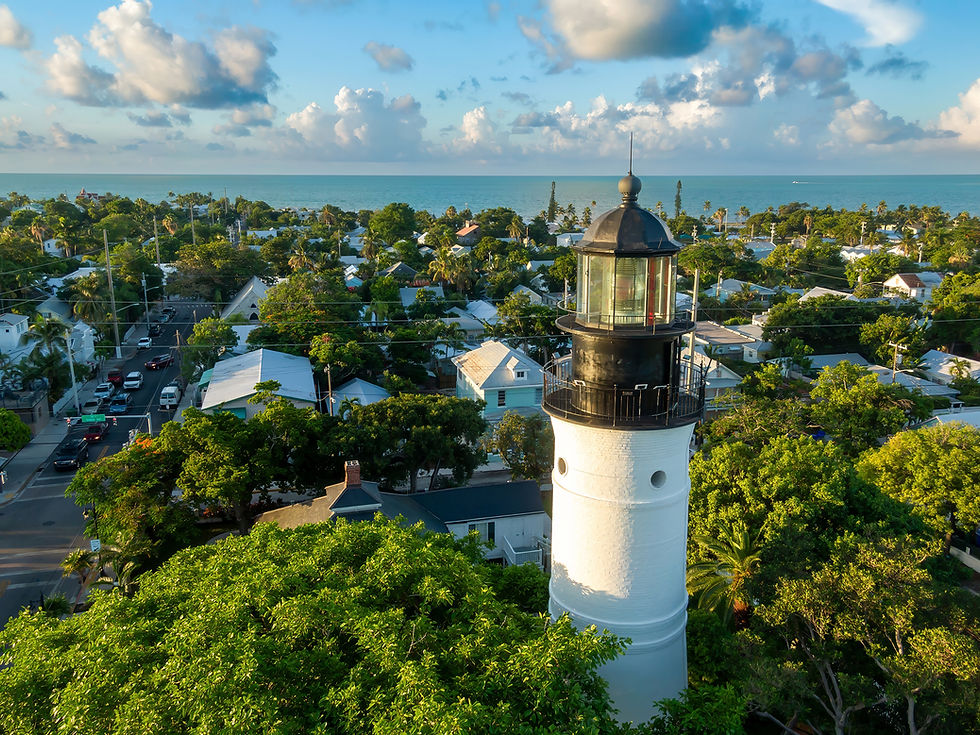
The Hemingway Home and the Tennessee Williams Museum are not Hollywood Regency, but they belong to the same era and are worth the walk. The Hemingway Home is about ten minutes from Marrero's, directly across Whitehead Street from the Key West Lighthouse, whose private sunset experience looks out over Hemingway's garden.
Hollywood Regency at Marrero's Guest Mansion
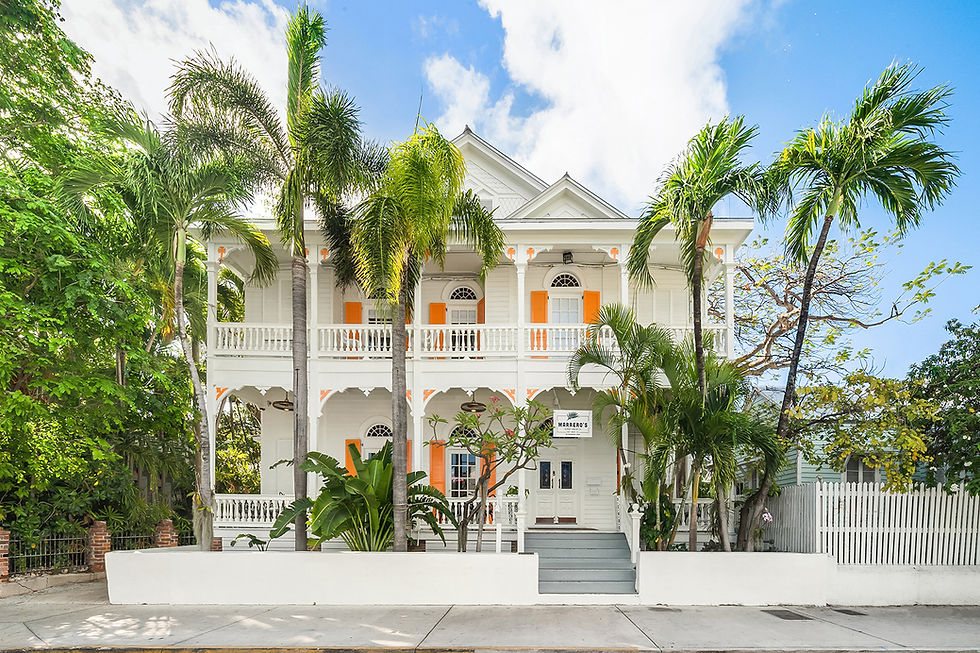
Marrero's was built as the family home of Francisco Marrero, a cigar maker who grew wealthy importing tobacco from Cuba, and his wife, Enriquetta. Their story did not end happily, and many believe Enriquetta never left; you can read the full history on our site.
In 2021 the house came into the ownership of {verdigreen} hotels, and a renovation and redesign followed. Two pieces of the Marrero's own house survived everything since, and both are still here.
The tobacco leaves on the staircase
As you climb the main staircase, look at the right-hand wall below the chair rail. The intricate carved relief there is overlaid with real tobacco leaf samples that Francisco brought back from his sourcing trips to Cuba. It is the business that built the house, pressed into its walls, and it sits in striking contrast to the Victorian detail around it.
Enriquetta's piano
When Francisco promised Enriquetta a home in Key West, she asked for one thing: a piano.
She was a pianist and loved to play. Francisco had one custom-made for her in walnut burl by Henry Brinsmead in Oxford, and shipped it across the ocean with an entire boatload of fine furnishings made for the new house.
The ship reached Key West harbor. The couple went down to see their furniture, Enriquetta's piano among it, and arranged for movers to unload everything into the mansion the following morning. That night, the boat sank with all of it on board.
Enriquetta would not let the piano go. She had wreckers bring it up from the sunken ship and deliver it to the house anyway. It never played again: the strings rusted and the soundboard warped. But it stayed in the house as proof of Francisco's devotion, and perhaps as a sign of what was to come. It still stands in our first-floor hallway today.
The look today

The redesign takes its cues from the same place Hollywood Regency did. Draper's love of pattern and Haines's glamour run through the house: bold pinstripes, clashing prints, tropical botanicals and saturated color playing off each other in every room, set against the tall windows and Victorian bones of the original mansion. The golden age of film helped put Key West on the map for travelers, so it seemed right to honor it here, with a modern and distinctly Key West spin.
Every room takes the look in its own direction; you can see them on our guest rooms page.
We hope you have enjoyed this look at old Hollywood, Key West and the house on Fleming Street. We look forward to hosting your next Key West stay.
The Marrero's Team

